Friday, 29 July 2011
Conglomerates Kill Luxury
Sunday, 3 July 2011
Where to with Luxury
The Millward Brown brand report has an interesting section on Luxury – well it’s not luxury at all rather an interesting section on luxury brands.
According to the report the current market of the top 10 luxury brands have a combined brand value of nearly 65.5 billion Dollars - I wonder does this really imply that they are manufacturing luxury goods or simply, as I have said before, mass producing tat to be consumed by the masses.
Millward Brown suggest that 'in general, Moët & Chandon, Louis Vuitton, Hermès, and the other luxury brands ranked high in brand contribution emphasized heritage and craftsmanship and limited distribution in the “mass luxury” market'. I do understand how a luxury brand can emphasize heritage because heritage adds value but how they can emphasize craftsmanship and limited distribution when their products are mass produced is confusing. But how can a brand limit distribution when their combined brand value exceeds 65.5 billion Dollars and they retail their goods around the world? Surely this is a contradiction in terms. They also go on about ethics and how consumers are no longer consuming conspicuously but are concerned with the origins of the product and how craftsmanship is once again becoming important. Are luxury brands really concerned with ethics, sustainability and the origins of their materials? I may not be looking hard enough but I have yet to find a luxury brand that has a Walmart type sustainability index. If Walmart can do it...
Millward Brown also note that luxury brand value is down 13% overall, they say that 'while the brand value of the luxury sector still lagged its pre-recession level, customers came back as evidenced by Burberry’s 86 percent leap and the brand appreciation of Cartier, Estée Lauder and Hermès.' Since when was Estée Lauder a luxury brand? This further emphasizes the confusion in the market. How are brands defined as luxury? And who decides?
The glory days of Louis Vuitton, Gucci, Chanel, Dior (not Christian Dior – that says it all) and even Hermes producing true luxury products are gone. That is not to say that don’t produce nicely made stuff – it’s just not luxury stuff. In my mind, cynical as I am, luxury brands are about money, making it for themselves and their shareholders.
Luxury, I am sure, will be re-claimed by the gifted craftsmen who embrace innovation, know how to ‘make’ and have an incessant desire to learn, teach and produce the most wonderful things.
Friday, 24 June 2011
Customizing Luxury?
I am not sure I agree with BOF when they suggest that ' it’s customisation platforms that have the ability to anticipate, and not just cater to, personal tastes in order to surprise consumers, as well as carry out their will, that may present the most potential for luxury fashion brands.' After all real luxury is concerned with satisfying the consumer in a very specific way and it could be argued that contact with the maker is crucial to maintaining the luxury ethos, something that a luxury brand is not really able to do.
Sunday, 12 June 2011
Luxury goods- how can 'luxury' be defined?
Tuesday, 8 February 2011
Where does everything go?
It struck me walking through Harrods, Selfridges, Liberty, Browns, Matches etc. how much stuff they still have on sale. Tonnes of it and all reduced. The savvy shopper doesn’t buy full price anymore when most of the stuff on sale is reduced at some point during the year. All the schmutter money can buy, all reduced and most still unsold is on sale should you want it. But what do the stores do with the stuff once the sales are over? There is talk that some of it is burnt in order to protect the brand. Odd when you think about it because in my mind brand protection is not about pilling high and selling low. It is completely the opposite. There must be mountains, or indeed landfill sites of luxury brand goods somewhere in the world- and I don’t mean at the discount villages on the outskirts of the major cities. And as China now becomes the focus of luxury brand retailers with an estimated growth in profits to something like $14.6 billion by 2015 more stuff will be produced. In reality it does not matter where the stuff goes all that really matters is that we begin to understand that the more that is produced the less of a luxury it really is.
Tuesday, 4 January 2011
‘Sale’ into a luxury brand
And so the luxury story continues. Come to think of it, it is not really a luxury story at all rather a luxury brand fairytale. The whole fashion cycle is becoming so boring. The stuff is more expensive than ever. I can’t believe anyone would pay full price for any of it and as the sales start earlier and earlier there is no real need. And so the sales begin.
Not content with selling their wares in airport shopping malls or discount outlets you can buy discounted luxury brands online. Forget paying full price at Net A Porter or the brands own websites. Don’t even bother going to the stores. Try all year round discounted goods at brandalley, cocosa or secretstyle. If you fancy a pair of Gucci or Dior shoes, a Fendy bag or Stephen Webster jewellery, they have it all. Despite Gucci telling us through their advertising that all the goods are beautifully made by men in white coats in a hazy workshop, the reality is that the goods are still mass produced, probably somewhere other than in Italy, and are not luxury at all. The days of the consumer respecting the artisan are long gone. Talented designers, makers and innovators are replaced by formulas that guarantee sales.
What is frustrating is that the consumer is none the wiser. What do they care if their jacket, jumper, skirt or bag is one of thousands. What they do care about is that it has a logo. To them the logo says luxury. And in reality that is all that matters, to the consumer and the retailer.
What strikes me as odd is that the luxury brand retailers spend millions of Dollars trying to protect the brand image but care little for where the product is actually sold. Why sell a £1000.00 handbag on a website that also sells Calvin Klein swimming trunks for a fiver? Even worse why sell a £1000.00 bag on a website that sells a Woodland Leather (who are they?) jacket for £150.00? What about protecting a brand when it needs it most? Shifting product is the aim of the game. To be honest a sale is a sale no matter where it happens so long as the product sells.
Thursday, 30 December 2010
Murano Glass - Carlo Moretti

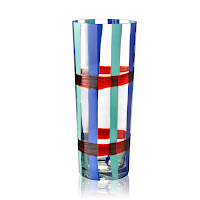
Finally Selfridges have come to their senses and started selling some decent Murano glass having removed it from the shelves a couple of years ago. Now, once again, you can buy Carlo Moretti and Cenedese in the glass department. Stupidly Harrods has redesigned their glass hall and now focus on the most garish pieces money can buy. They no longer sell Carlo Moretti or Cenedese. All a bit odd how the Buyers decide what to buy or not to buy in this case. One year they all sell it, the next no one sells it, then one sells it again when the other doesn’t. The only decent stuff Harrods now have is by the Czech glass maker Moser. And Moser is amazing, beautifully crafted, superb polishing all in amazing colours with the most fantastic engraving money can buy, should that be your thing. I have pieces by all of the above but thought I would share the Troncono ‘Conical Trunk’ which I bought at Harrods (before they stopped selling Moretti obviously).
On the Carlo Moretti website it says that it is a limited edition of 300. Weird, because I have number 82 / 333.